Tolkien dives into a bit of a history dump when the Hobbits approach Bree, which is good since we know little to nothing about the non-Hobbit world thus far. Remember, the story begins with a lengthy exposition on Hobbits and their customs, we can’t expect there to be no exposition here.
For this post, I want to explore the people and history of Bree and do so by looking at some maps of it in relation to the old kingdoms. I think this is very important because it sets the stage for why Bree is easily the most diverse village we see during the trip (including the much larger city of Minas Tirith) and why its important that the Hobbits experience this first.
First, the Bree folk claim to be original inhabitants of the land, there long before the Kings came across the sea (meaning the Numenoreans) so Bree is an old village indeed. In fact, when Arnor (the northern kingdom was established) they simply said Bree was within their borders and the Bree-landers readily agreed.
The men of Bree are likely akin to the Dunlenders (remember those folks that hate Rohan so much?) as native men who never crossed the sea and settled west of the Misty Mountains. By the same token, they are both closer related to the Rohirrim than they are to Aragorn or the other individuals of Numenorean blood.
Here are several maps centered on Bree land that illustrates its importance. To understand it completely, a quick history lesson on the time periods we’re talking about
1) Pre-Numenoreans
- Bree is settled by indigenous population of men
- Settled pre-third age so over 3,000 years earlier!
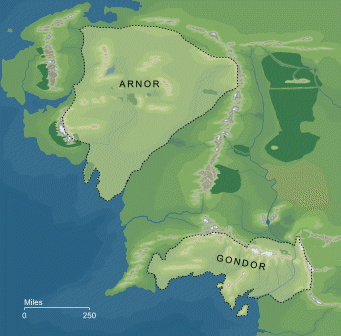
- Arnor was the Kingdom of the North of the Numenoreans who settled in Middle Earth. Gondor was the southern kingdom.
- Arnor was the more powerful, and the king ruled from Annuminas, which is directly north of the Shire and a ways northwest of Bree

- After 800 years of consecutive rule in the North, the King died and his three sons cannot decide who should rule.
- Annuminas, the former capital, is now in ruins after neglect.
- New capital, 100 miles north of Bree called Fornost is created.
- They split the kingdom in three
- Arthedain – the biggest and where the line of Isildur (Aragorn’s ancestors) continue to rule. Rules from Fornost, claims Bree and also controls Weathertop
- Cardolan – south of Arthedain, also claims Bree, but less powerful
- Rhudaur – From Weathertop to Rivendell and north, this kingdom is hills and forests and little else
- Angmar is located just to the north of Rhudaur and Arthedain and so the Witch-King places a puppet of his on the throne of Rhudaur. Angmar and Rhudaur team up to fight Arthedain and Cardolan.
- After long period of wars, Angmar wins, crushes Arthedain and destroys Fornost
- Note that this is over 1,100 years after the kingdoms split
- The last King of Arthedain is slain (Arvedui) and his son Aranarth decides not to rebuild the kingdom and becomes the first Chieftain of the Dunedain.

- Sometime during the rule of Arthedain and gigantic plague swept Middle-Earth reducing the populations substantially. This is why Bree is the largest city of men north of Edoras and is a village of ~100 houses
- Still on major crossroads, but with the fall of the kingdoms, there is no North-South road and the grass retakes the old trail.

 Lord of the Blog
Well I knew none of that, so its kind of a lot to take in. I figured that Bree was (or used to be) vitally important when Tolkien was discussing how the grass had over taken the North-South road. It makes sense then that this is the city to meet Strider and to take another dark and dangerous step towards the impending perils outside of the Shire. Bree is most certainly the gate to the outside.
Where does this information about a plague come in? One of the first things I thought of was how Bree seems quite important in the North but is not very heavily populated. Its a village, not a city. So is this plague responsible for the rather small settlement? Or do men just prefer the areas of Gondor and Rohan more?
LikeLike
The plague is essentially what destroyed the kingdoms and made them weak enough to fall to the Witch-King. It's part of the “Book of Lost Tales” which is a bundle of works published in the 70s from his notes.
Generally, the depopulation was very severe and the North was never really re-populated. There are villages and individual homesteads throughout, but no central area.
It's not really until you cross the Greyflood and go into Rohan that real settlements start cropping up and these are areas that, while hit by the plague, were partially spared and didn't have to jockey with Angmar for land.
So it's two parts:
1) Men live in Angmar which is ruled by the Witch-King (might be an evil empire, but still people)
2) The “good” people generally didn't want to be that close to Angmar.
Both points cause Breeland to be relatively sparse.
LikeLike