This post picks up where the last one left off, which is to say, after the first page or so. In this post, I wanted to look at just how strange Bilbo (and by extension Frodo) really seemed to others in the Shire and how, in some respects, they seemed destined for adventure.
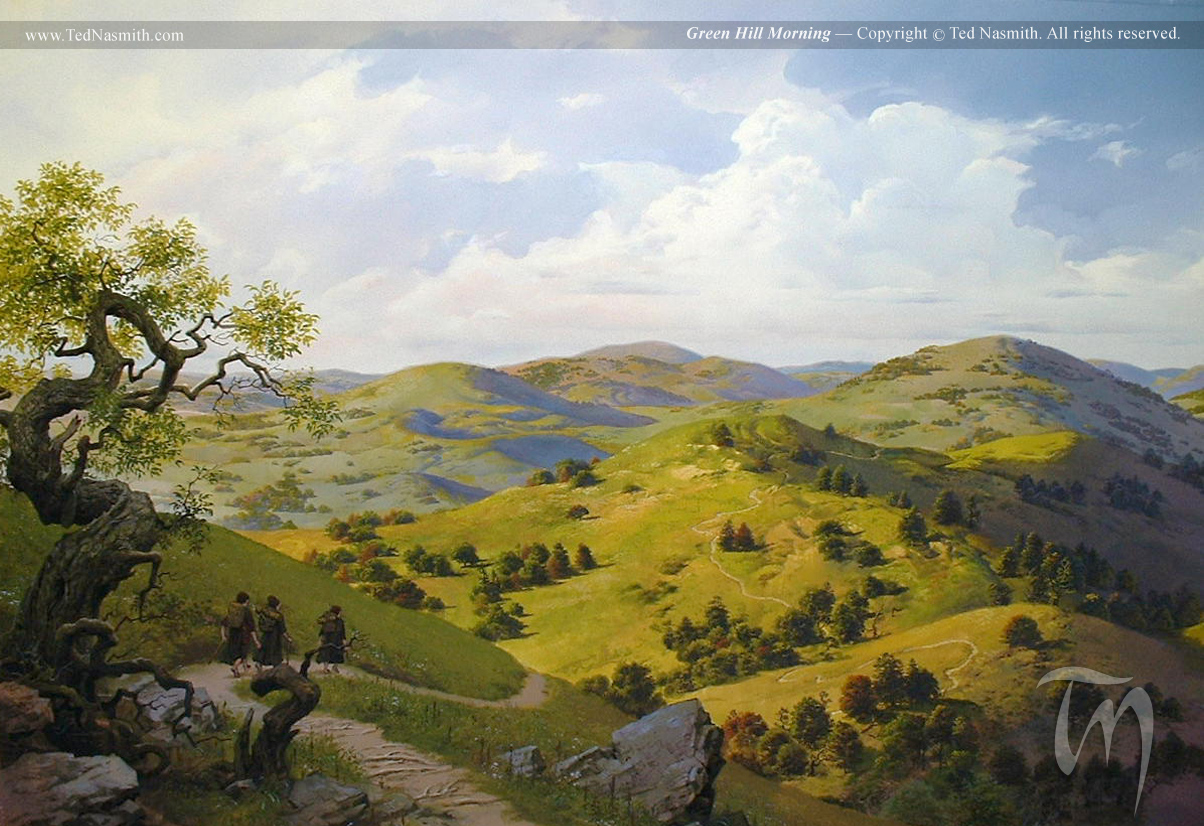 |
| Green Hill Morning by Ted Nasmith |
Strange Visitors
Dwarves
The chapter continues to describe Bilbo’s preperations for the party, which is the buzz of the entire Shire. Not only does Bilbo send for the bulk of the Shire’s cooks and food stores to serve everyone at his massive feast, but he has some odd visitors the movie left out as well. Early in the chapter, several dwarves come to Bilbo and stay with him throughout the week leading up to the party. At the Ivy Bush Inn, Sandyman, the miller, mentions that dwarves are relatively frequent visitors at Bilbo’s door and since he returned from his adventure 50 years prior, he has often disappeared for short stretches at a time.
I think this is very significant because it establishes that Bilbo is not a recluse (from the world, at least), and actively attends to his desire to get out and “see mountains”, so to speak. At the end of the chapter when Bilbo finally leaves, he does so in the company of three dwarves and they set out at a jog across the fields, not taking the shorter road.
Also, take a moment to check out this song recorded by The Tolkien Ensemble, a Dutch orchestra which wrote music to all of Tolkien’s lyrics and poems in the books. This is the first song in the book, the Walking Song which Bilbo sings while leaving.
If you cannot see the audio controls, listen/download the audio file here
Gandalf
Bilbo: “I suspect you know best”
Gandalf: “I do – when I know anything”
Gandalf is perhaps the strangest of the visitors to Bilbo. The ancient man appears without any specific description of his powers, but even Tolkien himself seems to respect them, describing them with the subtle and inherent respect that true power commands. Seen rarely in the Shire, and even then only for short periods of time and always in the company of Bilbo, Gandalf is eyed suspiciously as men are not seen often in the Shire.
Gandalf is a favorite character of mine and one we’ll be talking about much more in later chapters. For right now, I think the quote above is enough food for thought as we interpret Gandalf’s actions throughout the book. Clearly, his interactions with Saruman come to mind, as does his decisions in Moria. What other situations can you think of right now that we can examine through this statement?
Frodo
Frodo is interesting because he represents a new generation of Hobbits, caught between the traditional values of the Shire, and the tales of wonder and excitement of Bilbo. When Bilbo shares his plan to leave the Shire with Frodo, Frodo offers to join him and laments that he did not once Bilbo finally does leave. Clearly, he is not alone in this as the Gaffer bemoans their plight at the inn, “The legend of Bilbo’s wealth was now too firmly fixed in the minds of the younger generation of Hobbits.”
Merry, Pippen, and Sam clearly fit into this category (Sam is the one MOST enamored with Mr. Bilbo’s stories) and their actions combining traditional values with a new approach shape not only the Shire but the entirety of Middle Earth by the end of the tale.

 Lord of the Blog
Regarding Gandalf, I found myself wondering what you meant including that quote. To me, it means he is wise and fully capable of understanding anything and everything, but he is not omnipotent. I think maybe that is what you were getting at, but it was unclear since you didn't elaborate too much on your examples.
Since the Hobbit is fresher in my mind (by roughly ten years), and I haven't seen the movie yet, I was trying to relate to Gandalf as a character in that novel. What I found most interesting is that Gandalf doesn't seem to be presented as a all-powerful magician, nor is he devoid of all powers. This is made even more interesting by the depiction of him in the films, where I think his magic capabilities are even further reduced; his “spells” are seen as tricks or some derivative of his staff (the matrix-esque battle with Saruman comes to mind). In short, I suppose its up to the imagination as to what degree of “magical” powers the wizard actually has.
I think in order to further contribute to this I may have to back and reread the LOTR novels. Damn, my reading list just keeps getting longer!
LikeLike
Enjoyed both nook posts so far. Seems like one of the challenges you might run into (and that was obliquely addressed by Brandon as well) is that it'll be hard to fine too much support for themes of the books in individual chapters or parts of them. I wonder if you can use a tagging system to keep track of the themes and then make it easier to develop your analysis into a more complete work by going through the tags later – if you're at all interested in writing something other than blog posts, that is.
I'm bookmarking this, and I look forward to reading along. You have my… Attention.
LikeLike
Book* posts. Commenting from my phone.
LikeLike
This comment has been removed by the author.
LikeLike
In response to Brandon's post, I agree that Gandalf's magic was definitely different from book to movie. But I have found that in the books his magic isn't discussed as much. He does something and massive things happen (creating a barrier to stop the Balrog, scaring away the nazgul on the fields of Pelennor, and controlling Saruman's will. None of which are minor feats) but it's never discussed as to what he is actually doing. I like this though because the observers would have no idea what he is doing. To Pippen, it just looks like Gandalf turned on a glorified flashlight to scare away the Riders, when there is really more subtle things going on. I think that in the movies though, it's harder to show the power of his magic while not making him an omnipotent being. Kind of a fine line.
LikeLike